
The Project
Industry
Electrification – Electric Vehicles (EV)
CAPABILITIES APPLIED
SEEN ONLINE
Out of Re:Build’s early successes in industrial manufacturing, a bold concept emerged: develop a radically simple electric vehicle priced below $25,000 that rejected industry “feature bloat” to deliver basic, dependable transportation in a market where prices had risen out of control.
Phase 1: Strategic Foundation
Re:Build first validated the market opportunity and assembled a team to help define the product strategy. Rapid market analysis confirmed demand for a simplified EV positioned against increasingly complex and expensive vehicles. During this phase, the team developed the mission and vision framework, strategic brand positioning, and foundational product direction.
The company was initially incubated within Re:Build’s ecosystem, allowing the founding team to leverage integrated strategy, design, and engineering capabilities before spinning out as Slate, an independent entity.
Phase 2: Technical Execution
After becoming an independent company, Slate partnered with Re:Build to fill key engineering and manufacturing gaps. While Slate had established a vehicle design direction, it lacked the specialized expertise, supplier relationships, and manufacturing infrastructure required to design and validate a complete, low-cost platform while simultaneously designing scalable production systems.
Re:Build supported battery pack design, BMS electronics, and electromechanical integration, battery structural engineering and thermal management, electrical architecture and harness systems, scalable assembly automation, and advanced composite structural components. All development streams progressed in parallel under aggressive timelines.
Re:Build delivered coordinated engineering and manufacturing support across multiple disciplines. This approach applied Manufacturing Constrained Design™ principles from the beginning, allowing product design and production systems to evolve simultaneously while reducing coordination risk and accelerating development.
Re:Build led a four-to-six-week sprint transforming the vision into a clear product strategy and brand identity. Market analysis revealed an opportunity created by the industry’s shift toward higher-priced vehicles, leaving an underserved segment seeking simple, affordable, and dependable transportation.
Benchmarking validated the timing for a radically simplified EV platform and confirmed that customers would value affordability and customization over excessive features. The strategy supported a business model where accessory sales over time could generate long-term revenue.
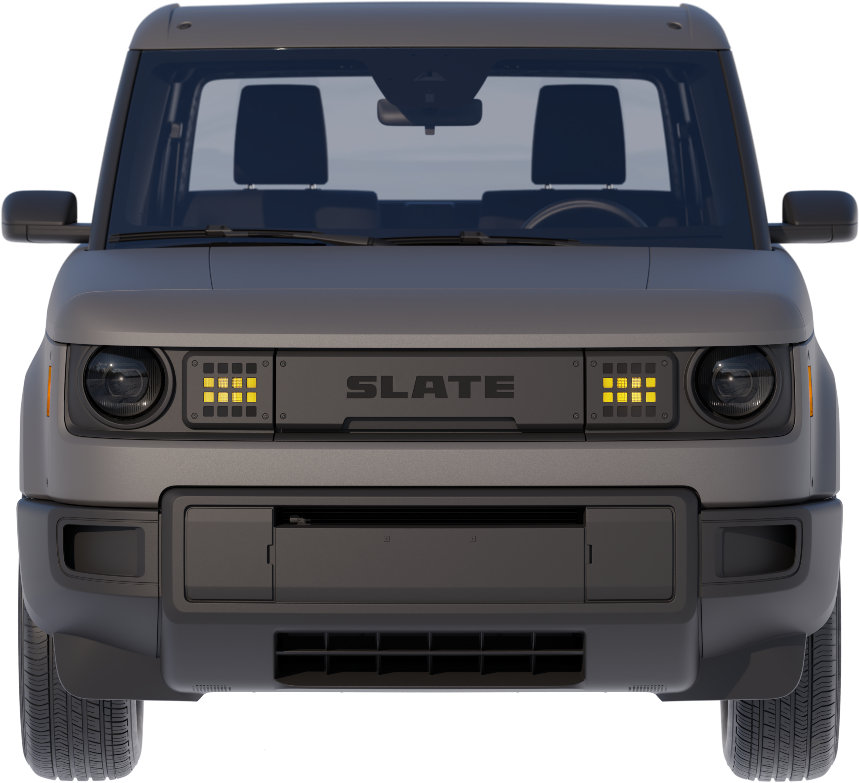
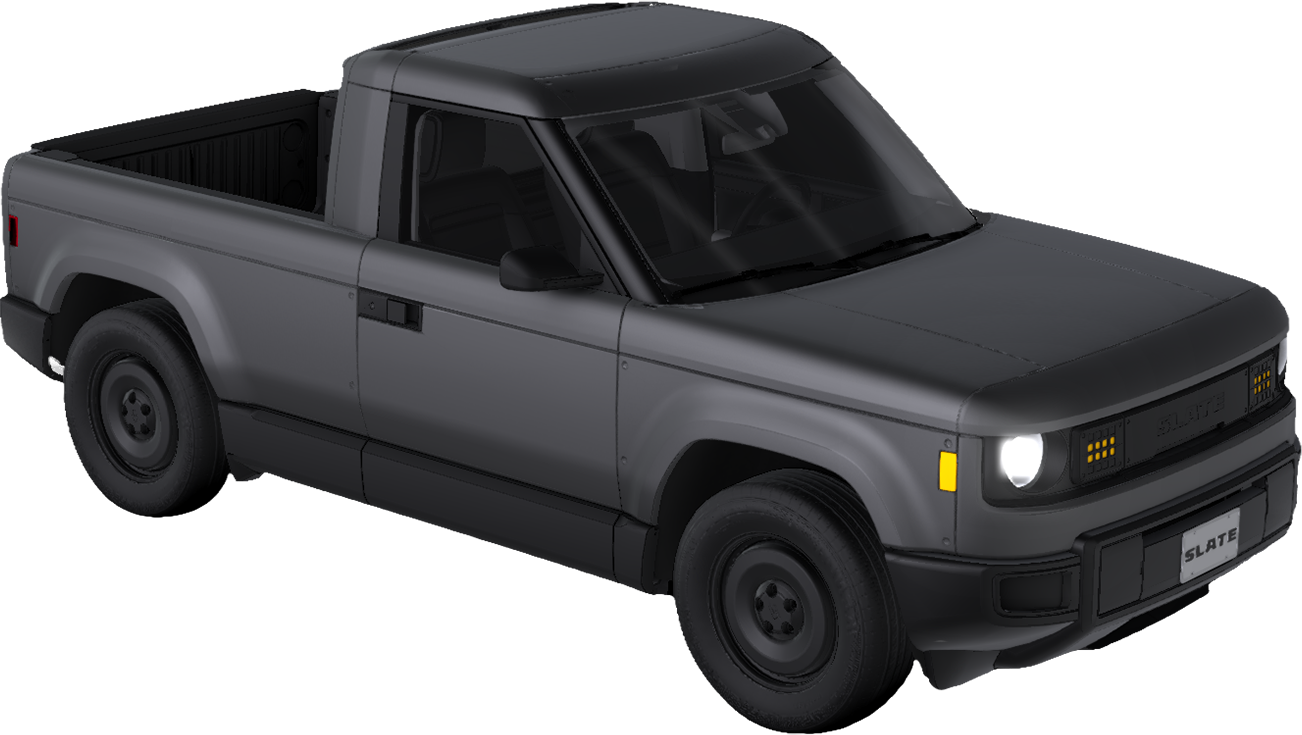
Re:Build’s industrial design team conducted a two-day workshop that translated the PRFAQ-defined vehicle concept into a clear product direction. Through collaborative sessions, the team refined the vision into a radically simple, two-door pickup truck with minimal complexity. The concept drew inspiration from iconic vehicles such as the Land Rover Defender, Ford Bronco, and International Harvester Scout to identify proportion rules that created a familiar yet modern appearance.
Full-scale mockups validated the concept that allowed the vehicle to transform from a pickup to an SUV. Packaging studies also supported a “grow with the family” philosophy, enabling the vehicle to expand from two seats to five over time. The final vehicle design remained closely aligned with the earliest sketches, demonstrating disciplined vision preservation throughout development.
Re:Build supported the development and refinement of Slate’s electrical architecture, implementing the Arcadia ECAD platform to create detailed wiring diagrams for low-voltage harnesses and vehicle subsystems including chassis, instrument panel, and lighting systems. Arcadia was introduced to bring structure to the evolving electrical system, enabling automated change propagation, improved documentation, and a more scalable foundation for ongoing development.
The ECAD platform also supported reusable component libraries and the documentation needed for future service publications. Re:Build further populated the Arcadia component database with parts and assemblies, creating reusable electrical assets that will support future platform evolution.
Re:Build supported battery pack product development for both standard-range and extended-range configurations aligned to Slate’s low-cost EV platform. The program utilized an existing reference pack design as a starting point, and Re:Build developed a new pack design from models and engineering analysis, balancing energy density, thermal performance, structural requirements, manufacturing cost targets, and scalability for higher-volume production. Manufacturability for Design™ principles guided the development process through weekly collaboration between product, battery, and automation teams, ensuring manufacturing constraints informed product decisions while design changes flowed directly into assembly system concepts.
To validate the design, Re:Build built approximately 70–80 validation battery packs using production-intent processes. These builds enabled testing and iterative refinement while informing scalable assembly line development. Re:Build also leveraged its supplier relationships to connect Slate with qualified battery cell manufacturers, resolving a key sourcing challenge and establishing a reliable supply chain foundation.
Re:Build supported development of the battery management system architecture and its integration with the vehicle’s electrical systems, including system monitoring strategies, safety controls, and electromechanical integration. To accelerate validation, the team developed a custom hardware-in-the-loop testing platform costing under $50,000 compared with commercial alternatives exceeding $200,000, enabling rapid testing and iteration of BMS functionality.
The system enabled automated BMS testing, simulation of battery behavior, and replay of real-world drive data. Engineers also designed key power distribution components including bus bars and battery disconnect units using electrothermal modeling to support high-voltage performance. Field testing, including extreme hot-trip testing in Arizona, provided critical validation data and informed ongoing BMS development and refinement.
Strategic Outcome: Slate experience directly informed Re:Build’s proprietary BMS Platform, now available for customization.
Re:Build supported development of the battery pack’s structural architecture using aluminum extrusions, cast components, liquid cooling plates, and stamped steel covers aligned with high-volume production requirements. The team performed engineering analysis to inform the design, including thermal modeling to evaluate heat transfer behavior and simulation-driven assessments of pack structural performance under representative load and impact conditions.
The team addressed structural challenges associated with long unsupported spans within the battery pack architecture, where loads and vibration can impact stiffness and durability. Through structural analysis, benchmarking, and iterative design development, Re:Build supported the design of a pack structure that balanced stiffness, weight, cost, and packaging constraints.
Re:Build recommended developing a proof-of-concept robotic cell early in the program to validate automation strategies before building the full production system. The validation system included a 200 kg robot, integrated safety systems, conveyors, AGV interaction, and custom end-of-arm tooling designed to simulate real production operations.
The cell confirmed robot payload capacity, reach, motion profiles, and repeatability while validating automation feasibility under production-like conditions. Insights from this system informed the design of a scalable battery assembly architecture aligned with high-volume production requirements.
Re:Build developed a large-format truck bed floor using glass-fiber polypropylene continuous-fiber reinforced thermoplastic composites. The component delivers steel-like structural strength while achieving approximately 50% weight reduction and built-in corrosion resistance.
Engineers created a proprietary manufacturing process combining automated tape laying with thermoplastic hot forming, enabling production volumes exceeding 100,000 units annually with approximately two-minute takt time. This design eliminates several traditional manufacturing steps including corrosion treatment and liner installation, simplifying production while maintaining durability.
Re:Build integrated manufacturing and automation engineers directly into battery pack design through weekly collaboration and shared CAD environments. This ensured manufacturing considerations influenced product decisions early while allowing design updates to flow directly into assembly system concepts.
Structured 3P and 2P lean events brought cross-functional teams together to optimize assembly workstations, facility layouts, and material flow strategies. Through physical mockups and layout simulations, teams evaluated alternative production concepts and developed optimized processes balancing automation investment, throughput, and operational efficiency.
Re:Build coordinated multiple specialized teams through structured program management and regular technical alignment meetings. Weekly leadership reviews aligned schedules, budgets, and priorities while engineering teams addressed integration challenges across disciplines.
This framework unified battery design, automation, structures, electrical systems, and composites under coordinated leadership. Product design and manufacturing system development progressed in parallel, accelerating decision-making and reducing program risk while maintaining continuity between early strategic work and later engineering execution.
Slate
Automotive
It’s a blank slate.
You call the shots.
It’s a blank slate.
you call the shots.
Vision Preservation
Intelligent ECAD Foundation
70 to 80 DV Packs + Strategic Sourcing
Structural Innovation
2 Minute TAKT Time at 100K+ Units per Year
Parallel Product and Line Development
Positioning a simplified vehicle architecture as a deliberate alternative to increasingly complex, feature-heavy electric vehicles.
This project established reusable capabilities across battery systems, automation, composites manufacturing, and supply chain development, supporting future programs and advancing scalable domestic EV production.
Comprehensive ECAD documentation established the electrical backbone for the vehicle platform.
Approximately 70–80 design validation packs were built using production-intent processes.
Beta fleet vehicles successfully completed extreme hot-trip testing without BMS issues.
Robotic validation confirmed automation feasibility and supported production architecture exceeding 150,000 packs annually.
Composite truck bed achieved ~50% weight reduction and scalable production capability.
3P and 2P events produced optimized manufacturing layouts and material flow strategies.
Simultaneous product and manufacturing development accelerated program execution.
The program leveraged U.S.-based engineering and manufacturing resources across Re:Build’s network.

