
In This Article
- Built for High-Volume Drone Production
- Designed Around the Drone
- Electrical Performance Under Load
- Mechanical Protection and Pack Durability
- Thermal Management and Cell Safety
- Cell Selection and Performance
- Designed for Production and Compliance
- Standard and Custom Battery Solutions
- Supplying Battery Packs at Scale
Built for High-Volume Drone Production
The United States is rapidly expanding its ability to produce drones at scale. What matters now is not development, but the ability to deliver systems in volume with consistent performance, reliable supply, and speed.
The Department of War’s Drone Dominance program is driving this shift. It is designed to move drone manufacturers into sustained, high-rate production, where success depends not just on how a system performs, but on how reliably it can be built, delivered, and supported over time.
At this scale, production challenges become system challenges. Components that worked in early builds must now perform consistently across thousands of units, while also supporting efficient manufacturing and a stable supply chain. Battery systems play a central role in this transition, influencing not only performance, but manufacturability, reliability, and the ability to sustain output.
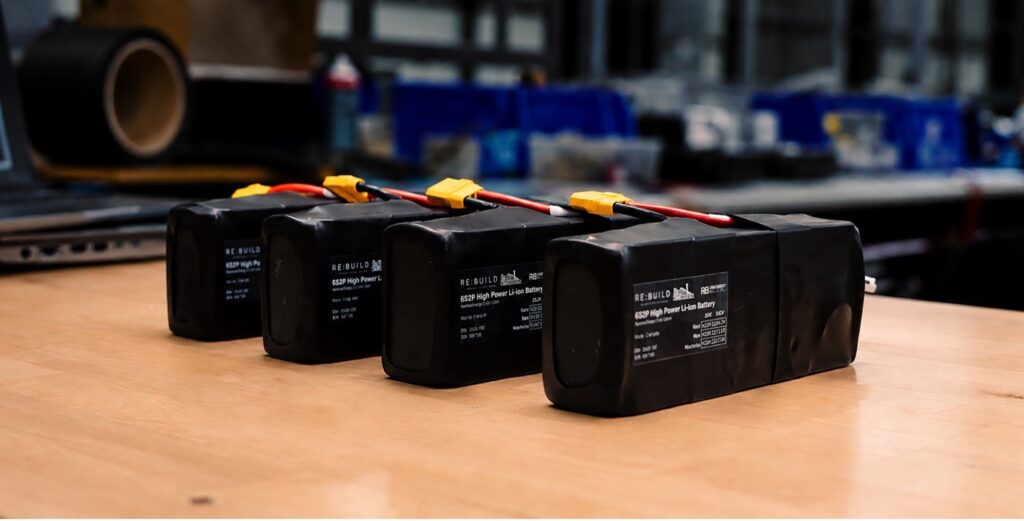
To support this shift, Re:Build Manufacturing is introducing a new line of drone battery packs built for high-volume production. Designed and manufactured in the United States, these systems are engineered to help drone manufacturers scale quickly with reliable performance and supply, aligning with the demands of modern drone production.
Designed Around the Drone
Re:Build battery packs are designed to fit the system they power, rather than forcing the system to conform to a fixed battery design. Most battery packs on the market rely on standard configurations where cells are arranged in simple rows or stacked layouts. While these approaches are easy to manufacture, they limit how effectively the battery integrates into the drone platform.
Re:Build uses custom-designed, laser-cut busbars to control both cell arrangement and current flow. This allows battery packs to be configured in geometries that align with the structure of the drone, including long, flat layouts that improve packaging efficiency and integration. The result is a battery system that works with the platform, improving both mechanical fit and electrical performance without introducing unnecessary constraints.
Electrical Performance Under Load
Battery performance is defined by how the system behaves under real operating conditions, not just by its nominal specifications. In many commercially available packs, weld quality introduces limitations that are not immediately visible. Inconsistent welds create localized resistance, which generates heat, reduces efficiency, and accelerates degradation over time.
Re:Build addresses this by designing both the materials and geometry of the busbars to support strong, consistent welds. By controlling how current flows during the welding process, more energy is directed into forming reliable connections rather than being lost as excess heat. This results in a battery that runs cooler under load, delivers more usable power, and maintains performance over a longer lifecycle compared to typical packs on the market.
Mechanical Protection and Pack Durability
Drone battery packs operate in environments where vibration, handling, and impact are common. Many battery packs rely on thin PVC shrink wrap as their primary form of protection, which can crack or degrade after repeated use or a single significant impact. Once compromised, the internal components become more vulnerable to damage.
Re:Build uses more durable polyolefin materials along with reinforced internal construction to better protect the cells. This approach improves the overall structural integrity of the pack and helps ensure that it continues to perform reliably over time. By designing for real-world conditions, the battery remains stable and functional even in demanding operational environments.
Thermal Management and Cell Safety
Battery safety is heavily influenced by how cells are arranged and how failures are managed within the system. Many battery packs place cells directly against each other, allowing heat and failure events to propagate quickly from one cell to the next. In some designs, venting from one cell can be directed into adjacent cells, increasing the risk of cascading failure.
Re:Build incorporates controlled spacing between cells and uses custom cell holders to maintain that spacing. This improves thermal management and reduces the likelihood that a failure in one cell will impact others. These design decisions enhance both safety and performance while maintaining a lightweight and efficient structure.
Cell Selection and Performance
Cell selection is one of the most important factors in determining overall battery performance. Many battery suppliers rely on cells that are widely available on the open market, which are often older designs with higher internal resistance and more limited performance under load.
Re:Build works directly with leading cell manufacturers to access a broader range of advanced cell technologies. This includes newer cells with lower impedance, which allows for higher current draw and improved thermal behavior. In practice, this results in better power delivery, cooler operation, and more consistent performance in demanding drone applications.
Designed for Production and Compliance
As production scales, requirements around shipping, certification, and compliance become increasingly important. Many battery packs available today are not designed with these constraints in mind, which can introduce risk when moving into higher production volumes.
Re:Build designs battery systems with these requirements as part of the development process. This includes alignment with standards such as UN38.3 certification, which is required for legal shipment at scale. By addressing these considerations early, battery systems can be produced, shipped, and integrated without disrupting production timelines.
Standard and Custom Battery Solutions
Drone manufacturers have different needs depending on their stage of development and production. Some require battery systems that can be integrated quickly and produced at volume, while others require solutions tailored to specific platforms and performance requirements.
Re:Build supports both approaches. Standard battery packs are available for programs that need to move quickly into production, while custom battery systems can be developed to align with specific platform requirements. In both cases, the focus remains on delivering battery systems that support reliable, repeatable production at scale.
Supplying Battery Packs at Scale
Re:Build manufactures drone battery packs in the United States for customers requiring reliable, high-volume supply. These battery systems are designed for consistent electrical performance, manufacturability, durability, and production scalability across both standard and custom drone platforms.
By combining advanced battery design with domestic manufacturing capability, Re:Build can supply drone manufacturers with battery systems at the volumes required for sustained, high-rate production.
For companies participating in Drone Dominance, the battery is not a secondary component. It is a critical part of delivering systems at scale, and a key factor in ensuring long-term program success.
Tell Us About Your Drone Platform
From rapid integration of standard battery packs to fully custom battery systems, Re:Build supports drone manufacturers with U.S.-manufactured solutions designed for high-rate production, reliable performance, and scalable supply.
