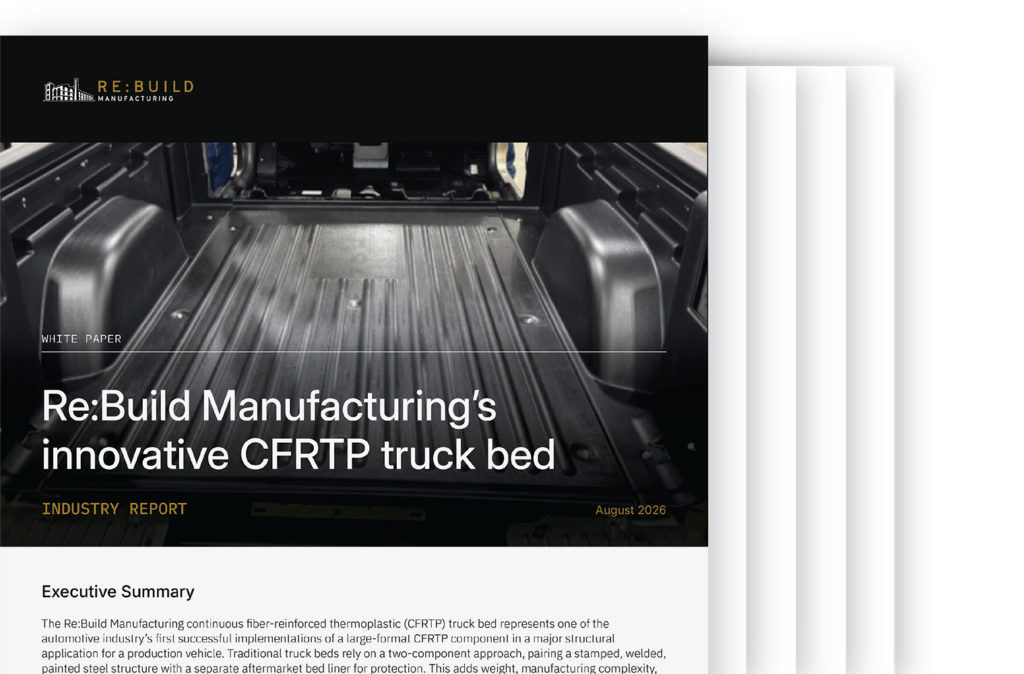
Re:Build delivers continuous fiber-reinforced thermoplastic (CFRTP) at high volume, engineered to outperform traditional materials in strength, weight, and durability. Whatever platform you’re building, we’re ready to bring that same proof to your program.
A new material or process shouldn't feel like a gamble.
Automotive engineering and sourcing teams are under pressure to cut weight and simplify assemblies, but switching to an unproven material or an unproven supplier can put a program’s timeline, budget, and reputation at risk. Most composite pitches ask you to take that leap of faith.
We’re asking you to look at what’s already been built and tested.
Speed & Scale-Up
Getting thermoplastic composite automotive parts to full production volume is usually where good programs fail, but we have the expertise to get you across the finish line.
Prototype to full production volume – it’s worked for other programs, and it can work for yours too
Fully automated, from raw material to trimmed part
Durability
Our CFRTP is built to take a hit. Our composite structures have been proven under real impact and load conditions.
Withstood a weight-drop impact test with zero visible damage
Built to perform under real-world use, not simulated use
Part Consolidation & Simplification
Every fastener and joint in a multi-part assembly is a cost, a labor hour, and a place something can eventually fail.
One structural part replaces what used to take several
Fewer joints and fasteners to assemble and inspect
Lightweighting
Thermoplastic composites let you take mass out of the vehicle while holding onto durability and a simpler build.
Two to three times lighter and stronger than steel
Weight savings can translate into payload, range, or battery capacity
Watch our thermoplastic composites take a direct hit. No damage. See for yourself.
2-3x
Lighter Than Steel
80%
Shorter Cycle Times
0
Visible Damage Upon Impact
100%
Rustproof
Our CFRTP process was put to the test on an automotive truck bed program, consolidating parts, cutting weight, and holding up under real-world conditions. The result of a repeatable process ready to apply to your platform.
Is CFRTP suitable for structural automotive applications?
Yes. Carbon fiber reinforced thermoplastic (CFRTP) is well suited to structural automotive applications, and a completed truck bed program proves it. In that program, thermoplastic composite automotive parts performed under real structural loads and genuine impact conditions rather than controlled lab testing alone. CFRTP delivers this performance because it can be roughly 2 to 3 times lighter and stronger than comparable steel while resisting impact, corrosion, and dents. The result is a load-bearing component that stands up to real-world conditions while contributing to a lighter, more efficient vehicle.
How does this compare to metal stamping or legacy composites on cost?
When you look at total cost rather than material cost alone, thermoplastic composite automotive parts are highly competitive with metal stamping and legacy composites. The key is part consolidation. By combining several components into a single molded part, CFRTP reduces assembly labor and the number of joints, which typically offsets any difference in material cost and can simplify the overall production process.
Can this process actually scale to full production volume?
Yes. Producing thermoplastic automotive parts at full production volume is already a proven reality, not a goal. The process has made the transition from prototype to full production on real programs, supported by cycle time data and backed by fully automated production that runs from raw material to finished, trimmed part. That combination of automation and validated cycle times is what makes consistent, high-volume output achievable.
What does "part consolidation" actually save us?
Part consolidation means designing several individual components as one molded piece, and that simplification pays off in multiple ways. With thermoplastic composite automotive parts, fewer parts mean fewer joints, less assembly labor, and fewer potential failure points, which supports a more efficient build and a more reliable, finished component.
How much weight can we actually save compared to steel?
Quite a bit. Based on direct strength-to-weight comparisons, thermoplastic composite automotive parts run roughly two to three times lighter and stronger than steel. That means you can reduce weight to improve vehicle efficiency without giving up structural strength, since the material delivers gains on both fronts at once.
Contact Us
Talk to an Engineer
If you’d rather skip the download and ask an engineer directly, we’re happy to jump on a call.