The Project
Industry
Electrification – Wire Harness Manufacturing
CAPABILITIES APPLIED
Analog formboards are widely used in wire harness manufacturing to ensure accurate routing and consistent assembly, but they come with several challenges. The installation and changeover processes are highly manual and labor-intensive, which can slow production and increase the risk of human error. Formboards also require significant factory floor space and must often be rebuilt or modified when harness designs change, making engineering updates costly and time-consuming. As harnesses become more complex and product variants increase, manufacturers must manage many different boards, leading to operational inefficiencies and limiting scalability. Without real-time verification or step-by-step instructions, operators often lack immediate feedback on assembly accuracy, increasing the risk of costly defects that may only surface during final testing or after installation in the field. In highly regulated industries like aerospace and medical devices, these inefficiencies often translate into wasted materials, delayed production, and tighter profit margins.
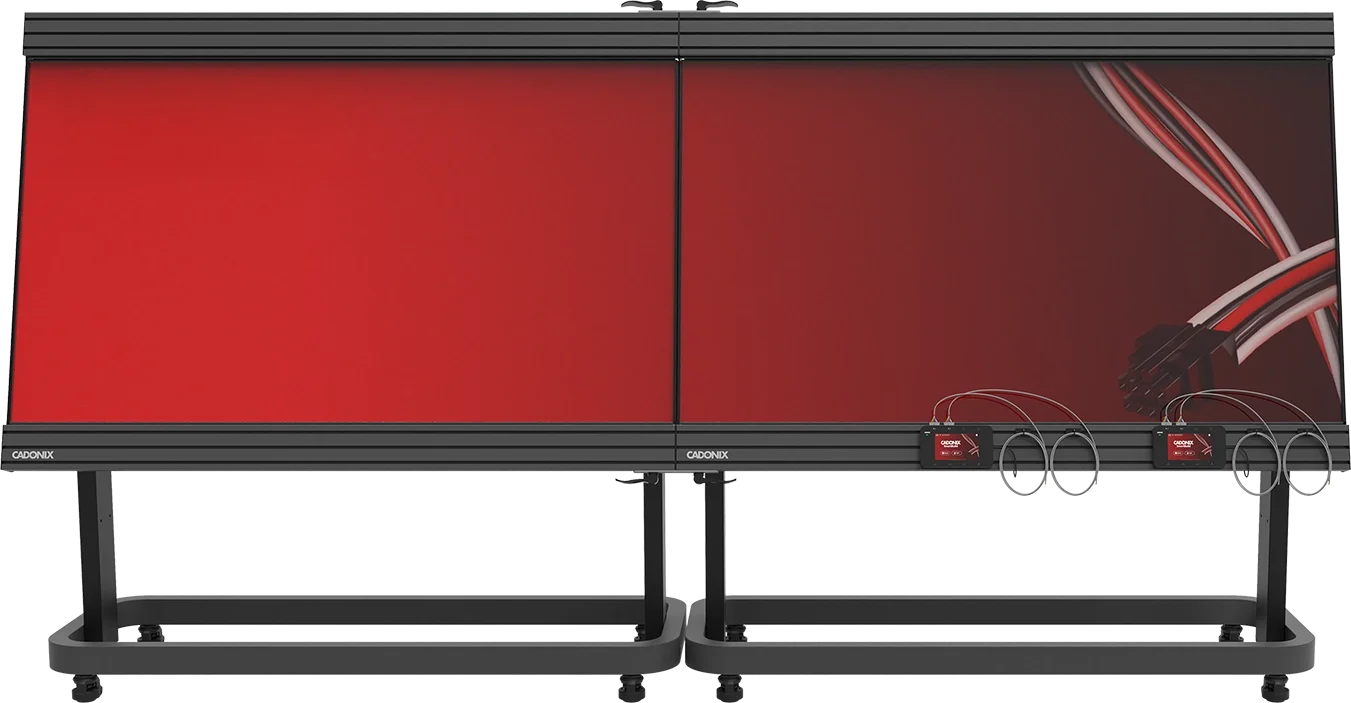
Recognizing that manufacturers needed a turnkey solution, Re:Build designed and developed “smartBuild”, a dynamic digital platform that guides operators through assembly, verifies quality in real-time, and adapts instantly to design changes. Through onsite observations and discussions with wire harness manufacturers, Re:Build learned the must-haves in this production environment. This knowledge was essential in developing all components to work together including the Digital TV formboard, Unified Controller/Tester, and Fixtures for work holding. The result is a solution that arrives pre-configured, pre-tested, and ready to assemble, allowing manufacturers to focus on what they do best, building wire harnesses, rather than becoming systems integrators.
Rather than selecting off-the-shelf materials, the team created purpose-built hardware optimized for manufacturing environments. This includes a custom stand with adjustable heights, industrial casters, integrated controller mounting rails, and a durable acrylic display surface that allows visibility to wire harness build information while protecting the display in fast paced manufacturing environments. Every component selection, from display technology to caster specifications, was made with deployment speed, durability, and user experience in mind, ensuring manufacturers could unpack and start producing in hours.
The development team architected seamless integration between the Arcadia design platform and smartBuild hardware, developing the data transfer protocols, user interface workflows, and system architecture that allow designs to deploy quickly. Beyond simple deployment, the system enables users to manipulate and refine build sequences directly on the production floor, empowering operators and engineers to develop optimized production processes based on real-world experience. The digital formboard deployment system eliminated traditional printing and storage, while a revision management system pushes updates across all stations instantaneously. This infrastructure ensures every operator always has the latest design without delays or outdated documentation.
Re:Build conducted extensive user research with wire harness operators to understand their workflows, challenges, and learning curves, then designed visual guidance that highlights wire paths, splices, and terminal placements in intuitive, easy-to-follow sequences. Through multiple prototype iterations and real-world testing, the team engineered adaptive instruction algorithms that adjust complexity based on operator experience level, reducing cognitive load and minimizing errors while accelerating assembly speed. The result is an interface that balances comprehensive guidance with production efficiency.
At-station testing capability came from integrating continuity testing directly into the smartBuild controllers which are the same devices that guide operators through assembly. This unified approach means operators use a single controller for both build instructions and quality verification, eliminating the need for separate testing equipment and making verification feel like a natural part of the assembly process rather than a separate step. The data capture and traceability systems log every test result, creating the foundation for zero-defect verification and compliance documentation.
Re:Build architected smartBuild as a scalable modular platform from the ground up, engineering flexible hardware mounting systems, adaptable software architecture, and networked controller infrastructure to support multiple-display configurations and varied deployment scenarios. Our engineering team developed a modular framework enabling displays to function as a unified system, handling harnesses spanning multiple screens while maintaining precise scaling and alignment. We designed flexible deployment options allowing smartBuild to serve either as an augmentation tool alongside existing formboards or as a standalone digital station, with modular components that can be expanded, reconfigured, or scaled to match evolving manufacturing needs and production volumes.
The complete cloud-based analytics platform captures, processes, and visualizes manufacturing data through infrastructure embedded in smartBuild stations. Cloud databases, processing systems, and dashboards give manufacturers actionable insights into production rates, station utilization, and quality metrics. This comprehensive data strategy, requiring expertise in IoT connectivity, data security, cloud architecture, and user interface design, turns every build into measurable intelligence for continuous improvement.
Re:Build developed the infrastructure required to manage and deploy digital formboards across smartBuild production environments, including cloud-based architecture, version control, and data distribution to connected stations. The team implemented automated update workflows, permission structures, and revision tracking to ensure only current design data is used during assembly while maintaining traceability. This work required reliable handling of complex CAD-derived data and consistent, low-latency deployment, enabling practical use of digital formboards in real-time manufacturing environments.
Throughout development, Re:Build’s engineering team tackled the complex challenge of creating fixtures that could hold wire harnesses securely during assembly on the vertical display surface. This required navigating intellectual property constraints, testing multiple materials and mechanisms, and developing solutions that could handle varying harness weights, withstand elevated temperatures, and remain reusable through hundreds of cycles. The team applied difficult testing protocols to validate fixture performance while designing the build station hardware for consistent assembly and quality control. This disciplined focus on manufacturability ensured smartBuild could scale from prototypes to production units with reliable performance.
smartBuild
Faster Builds.
Full Traceability.

Faster Builds.
Full Traceability.

Purpose-Built Hardware
Integrated Software Architecture
User-Centered Interface Design
Integrated Testing Architecture
Modular Platform Engineering
Data Platform Development
Digital Warehouse Engineering
Re:Build solved complex fixture challenges through material innovation, IP navigation, and rigorous validation for production-ready performance.
Years of successful customer implementation validate smartBuild’s real-world performance and reliability in demanding manufacturing operations.
Guided visual instructions and streamlined workflows accelerate assembly times, with customers reporting consistent 18-20% reductions in build time per harness across their operations.
New technicians become productive in their first day rather than after weeks of training. Adaptive guidance eliminates lengthy onboarding periods, dramatically reducing labor costs and improving workforce flexibility during scaling or turnover.
Manufacturers reclaim valuable floor space previously dedicated to formboard and documentation storage. smartBuild eliminates printing costs, storage overhead, and errors from outdated or misplaced physical boards.
Real-time continuity testing identifies assembly errors during the build process when they’re easiest and least expensive to correct. Customers report dramatic reductions in rework and scrap rates compared to end-of-line testing approaches.
Cloud-based tracking provides full visibility into every harness built—revisions used, build sequences followed, test results recorded, and performance metrics captured. This traceability satisfies quality audits and compliance requirements while enabling data-driven continuous improvement.
Digital formboard deployment eliminates 95% of design-to-build time and puts process optimization in operators’ hands. What previously required days or weeks of printing, distributing, and storing physical boards now happens in seconds, while the ability to refine build sequences on the fly lets manufacturers continuously improve workflows without waiting for formal engineering updates. Whether responding to design revisions or optimizing assembly steps based on floor experience, manufacturers can adapt to engineering changes and customer requests with unprecedented agility.