The Project
Industry
Aerospace & Defense – Unmanned Aerial Vehicles (UAVs)
CAPABILITIES APPLIED
Developing advanced unmanned aerial vehicles typically involves lengthy timelines, fragmented supply chains, and the challenge of balancing aerodynamic performance with manufacturing feasibility. UAV developers face a critical gap between initial concept and flight-ready hardware, where design iterations, prototyping delays, and vendor coordination can stretch programs across multiple years. The industry needed proof that a complex UAV could be taken from initial concept to successful flight test in an aggressive timeline.
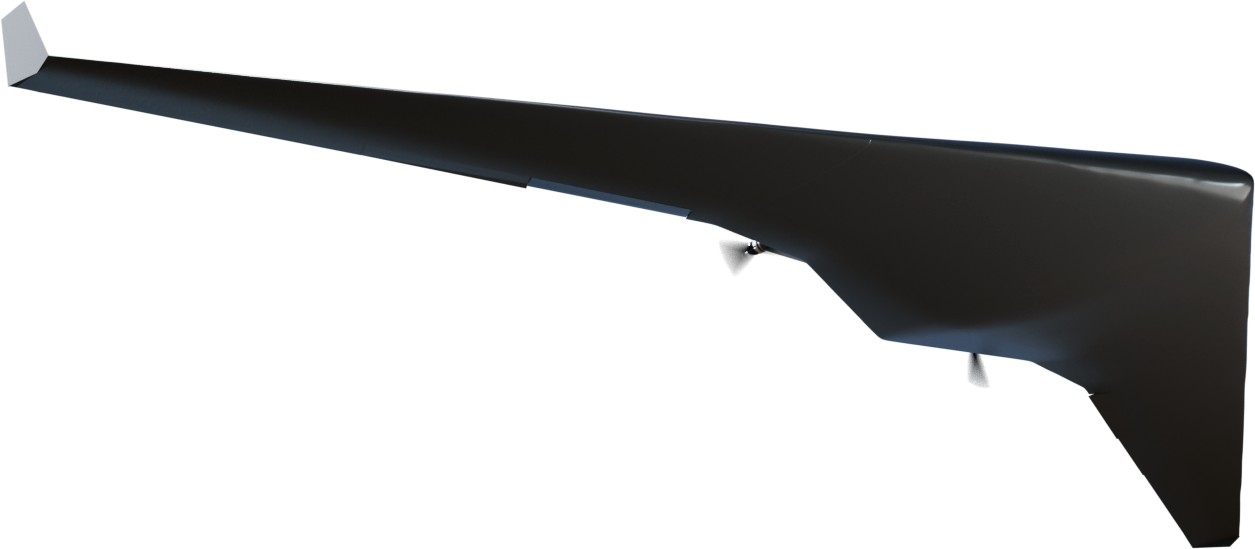
Re:Build Manufacturing delivered the XRAE-1 Foundation large flying-wing UAV as a rapid technology demonstrator in just four months from concept to flight test. By empowering a focused, multidisciplinary team with full autonomy, in-house prototyping capabilities, and access to Re:Build’s ecosystem, the program proved that aggressive timelines are achievable without sacrificing engineering rigor or production readiness.
Re:Build developed proprietary software tools specifically for the XRAE-1 Foundation’s configuration optimization based on mission requirements. These tools predict performance, flight dynamics, structural margins, and mass properties from the outset, enabling virtual design validation that avoids costly iteration cycles. By tightly coupling design tools with manufacturability understanding, the team ensured the vehicle would both fly well and be built efficiently.
The team deliberately chose a large flying-wing design, an aerodynamically and structurally challenging UAV architecture. This decision ensured that if Re:Build could successfully develop a large flying wing, more conventional drone architectures like multi-rotor or tilt-rotor, would be well within reach. Advanced simulation tools evaluated aerodynamic trim, center of gravity placement, and flight stability early in the design process.
Re:Build engineered a composite airframe optimized for the challenging large flying-wing configuration, with careful attention to structural loads, weight distribution, and manufacturing processes. The design leveraged bond coupon tests and full-scale structural evaluations to validate and inform simulation results, increasing confidence in the final design through correlation of physical testing with analytical predictions.
The prototyping process leveraged multiple in-house capabilities:
This build-test-learn-iterate approach provided essential data early in the program, enabling informed decisions that directly impacted the final airframe design.
Re:Build Manufacturing integrated and validated propulsion systems through comprehensive flight test profiles that evaluated motor and battery performance under real-world conditions. Through rigorous testing and optimization, the propulsion architecture achieved flight times ranging from 30 minutes at maximum power to over 3 hours with different battery/payload configurations.
The team developed flight control systems validated through simulation and iron bird testing prior to installation. Flight simulators previewed controls and stability characteristics, ensuring predictable behavior and control responsiveness. This hands-on, closed-loop validation process caught potential issues early and built confidence in the final product.
Re:Build’s domestic production network provides access to cost-effective capabilities from low-rate prototyping to full-rate production. Whether launching limited quantities or preparing for volume production, the solution can be tailored to meet both technical and commercial needs while maintaining quality and supply chain control.
Re:Build’s domestic production network provides access to cost-effective capabilities from low-rate prototyping to full-rate production. Whether launching limited quantities or preparing for volume production, the solution can be tailored to meet both technical and commercial needs while maintaining quality and supply chain control.
XRAE-1
Foundation
Precision Aerospace Components That Perform Under Extreme Constraints

Precision Aerospace Components That Perform Under Extreme Constraints

Proprietary Design Software
Flying-Wing Configuration
Lightweight, High-Strength Airframe
Motor & Battery Performance Validation
Simulator-Validated Controls
BUILD. TEST. LEARN.
In-house machining, composite tooling, and 3D printing accelerate development cycles.
Four-month concept-to-flight timeline demonstrated Re:Build’s ability to accelerate UAV development without sacrificing engineering rigor. This represents significant acceleration compared to traditional multi-year UAV programs.
Successfully developing a large flying-wing architecture, a challenging UAV configuration, validated Re:Build’s capability to handle any conventional drone platform including multi-rotor and tilt-rotor designs.
Maximum speed of 75 mph, maximum takeoff weight under 55 lb, and flight endurance of 2-3+ hours (depending on power settings and payload) demonstrated platform versatility for real-world missions across defense, commercial, and industrial applications.
Future iterations will explore integrated battery pack and BMS solutions from Re:Build’s energy storage capabilities, enabling tighter integration, improved efficiency, and rapid deployment of mission-specific power solutions.
The XRAE-1 Foundation serves as more than a technology demonstrator. It represents a proven development approach that customers can leverage for their own UAV programs.
Vertically integrated development and manufacturing capabilities with strategic supplier partnerships provide supply chain flexibility, reduce dependencies, and support requirements for controlled, secure production.
16-foot wingspan, 30.5 ft² wing area, retractable landing gear, and 43.5 lb empty weight demonstrate the platform’s sophisticated design and performance capabilities suitable for demanding operational environments.